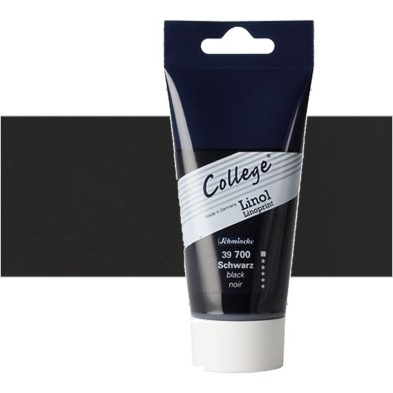
What is Schmincke College Linoprint ink?
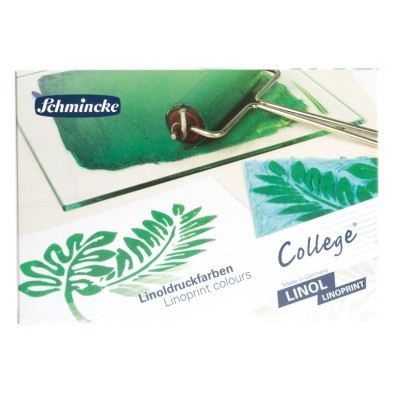
College Linoprint (College Linol, series 39) is the student-quality lino printing ink from Schmincke, the German artists' colour maker founded in 1881 and based in Erkrath. It is a water-based, water-soluble ink with a low odour which, according to the maker, is easy to apply and prints evenly, both as a single colour and in multicolour prints. Schmincke presents it as an introduction to linocut and recommends it for educational use.
College colours mix well with each other and, according to Schmincke, can be combined with all the linoprint mediums in its professional range, explained below. If you are looking for other water-based inks for paper, or for fabric printing inks, you will find them all under linocut and woodcut inks.
College Linoprint colours and sizes
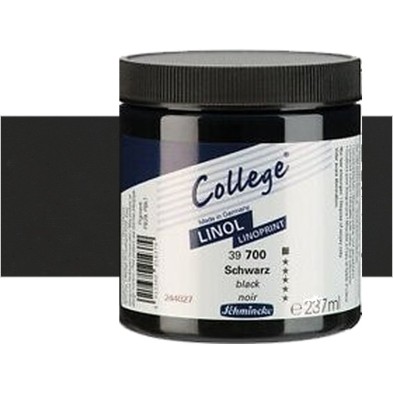
Schmincke's colour chart has 16 colours, three of them neon (yellow, orange and magenta). All are made in 75 ml plastic tubes, and white and black also in 237 ml jars. There is also a set of five 75 ml tubes in white, light yellow, red, blue and black, the basic colours for mixing: Schmincke points out that mixing them greatly extends the palette, and in one of its examples it mixes red and blue to make violet.
College Linoprint colours (selection): pigments, lightfastness and opacity according to Schmincke
| Colour | Article no. | Pigments | Lightfastness | Opacity |
|---|
| White | 39100 | PW6 | Highest | Opaque |
| Light yellow | 39200 | PW6, PY3 | Very good | Semi-opaque |
| Yellow orange | 39250 | PW6, PY74, PY83 | Good | Semi-opaque |
| Red | 39300 | PR112 | Very good | Semi-opaque |
| Dark red | 39350 | PR170 | Good | Semi-opaque |
| Blue | 39400 | PB29 | Very good | Transparent |
| Dark blue | 39450 | PB15:1 | Highest | Opaque |
| Green | 39550 | PG7, PG36, PY74 | Very good | Opaque |
| Black | 39700 | PB29, PBk7 | Highest | Opaque |
| Neon yellow | 39840 | Fluorescent pigment | Not stated | Transparent |
| Neon orange | 39850 | Fluorescent pigment | Not stated | Transparent |
| Neon magenta | 39870 | Fluorescent pigment | Not stated | Transparent |
The opacity data helps when planning a multicolour print: a transparent colour, such as blue or the neons, lets the colour underneath show through, while an opaque one covers it. Schmincke also notes that a print that has already dried can easily be overprinted with another colour.
Schmincke linoprint mediums: what each one does
College inks can be used neat on paper or card. The LINO mediums, which belong to the professional Aqua Linoprint range and which Schmincke also recommends for College, add optical effects: depending on the one you choose, the ink becomes more transparent, glossier or takes on a pearlescent sheen. They are mixed into the ink undiluted, and the effect depends on the amount and on the colour: the more medium and the darker the shade, the clearer the effect. Like the inks, they dry smudge-proof but not waterproof, have a low odour and can be mixed with water. Adding them slightly extends the open time of the ink.
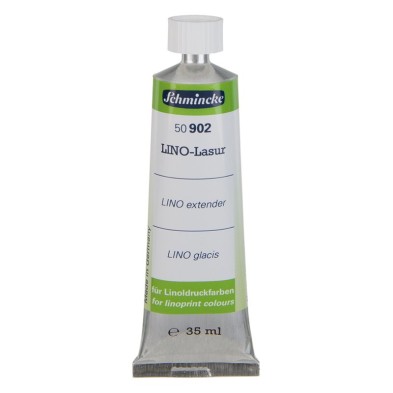
- LINO glaze (35 ml): a binder-rich medium that increases transparency. It is for mixing into the ink, not for printing on its own, at a ratio of at least 1 part medium to 5 parts ink. Its German name is LINO-Lasur, and in one of its guides Schmincke calls it LINO extender.
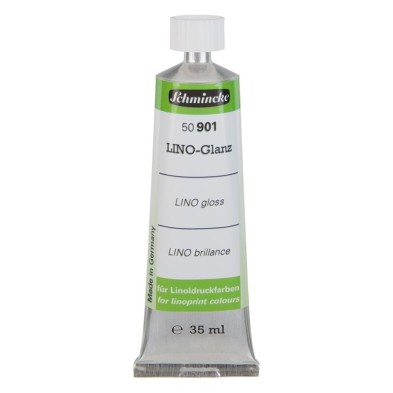
- LINO gloss (35 ml): binder-rich, it increases gloss and transparency. Mix it into the ink (at least 1 part to 3) or print it neat on top to add glossy accents.
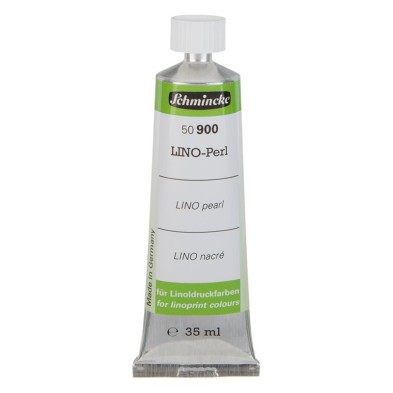
- LINO pearl (35 ml): gives a pearlescent effect. Mix it in (at least 1 part to 9 parts ink) or overprint it neat, which gives the strongest effect; it shows best with transparent and dark colours, and it makes the ink it is mixed with lighter.
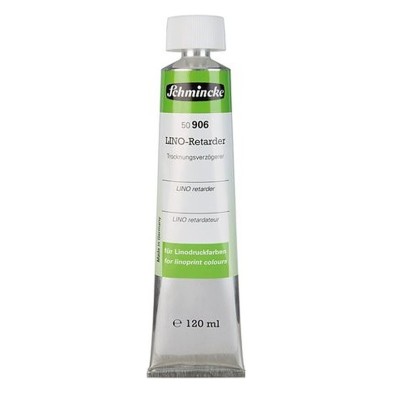
- LINO retarder (120 ml): the drying retarder in the linoprint range.
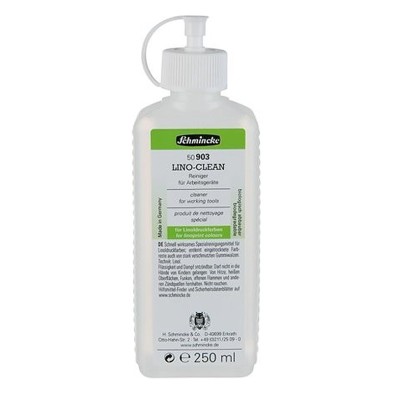
- LINO clean (250 ml): a dedicated cleaner for dried lino printing ink (see below).
How to print with College Linoprint
Schmincke sums up the method in a few words: roll the ink out thinly on a glass plate and apply it thinly to the block with the roller, then transfer the image by pressing evenly and calmly. You can print with a press or by hand, using the block like a stamp, and Schmincke uses College with both classic lino and carved rubber blocks. To ink up you need a lino printing roller, and to carve, one of the blocks for linocut and woodcut.
A tip from the maker: if the ink dries on the glass, you can reactivate it with a light spray of water and keep rolling until it regains its usual properties.
Cleaning, storage and water resistance
Fresh ink comes off with water, and the glass plate, roller, palette knife, brushes and blocks can all be cleaned with water. Even so, Schmincke recommends cleaning with LINO clean from time to time: a highly effective, biodegradable cleaner that removes dried ink residue even from very dirty rubber rollers. Unlike LINO glaze, LINO gloss and LINO pearl, which carry no hazard labelling, LINO clean is labelled as a flammable liquid and vapour that causes serious eye irritation, so keep it away from heat and flames and out of the reach of children.
Schmincke's lino printing inks and mediums should be protected from frost. Once dry, they are not waterproof: the print will not smudge when touched, but it is not meant for items that will get wet or for fabric that will be washed.
Frequently asked questions about Schmincke lino printing ink
What is Schmincke College Linoprint ink?
It is Schmincke's student-quality lino printing ink (College Linol, series 39): water-based, low-odour and designed to print evenly. The German maker developed it for beginners and for educational use, and makes it in 16 colours, three of them neon, in 75 ml tubes, with white and black also available in 237 ml jars.
What does each Schmincke linoprint medium do?
According to Schmincke, LINO glaze increases transparency and is mixed into the ink; LINO gloss increases gloss and transparency, and LINO pearl gives a pearlescent effect. These last two can also be printed neat on top to add accents. The effect grows with the amount of medium and the darkness of the colour. LINO retarder is the drying retarder and LINO clean the cleaner.
Can LINO mediums be used with College ink?
Yes. The LINO mediums are part of the professional Aqua Linoprint range, but Schmincke states that all College colours can be combined with them. They are mixed in undiluted, slightly extend the open time of the ink and, like the ink, dry smudge-proof, have a low odour and can be mixed with water.
Can Schmincke College ink be used to print fabric?
That is not what the maker recommends. Schmincke explains that its lino printing inks dry smudge-proof but not waterproof, and presents College for surfaces such as paper or card. That means the print will not survive washing. To print T-shirts or tote bags, you need a fabric block printing ink.
How do I clean Schmincke ink off my roller and blocks?
Fresh ink comes off with water, as does ink on the glass plate, roller, palette knife and brushes. For dried residue, Schmincke recommends using LINO clean from time to time, a biodegradable cleaner that works even on very dirty rubber rollers. It is labelled as flammable and as an eye irritant, so use it carefully and away from naked flames.
Which colours come in the Schmincke College Linoprint set of five?
According to Schmincke's colour chart, the five-colour College Linoprint set contains 75 ml tubes: white, light yellow, red, blue and black. They are basic colours for mixing: the maker points out that mixing them greatly extends the palette, and in one of its examples it mixes red and blue on the glass plate with the roller to make violet.