The PCF-350 brush tip: the only POSCA whose width is set by your hand
Everywhere else in the POSCA range the width comes from the nib: you pick a reference and you always get the same line. The PCF-350 works the other way round. Its tip is a polyester fibre brush that gives way under pressure and springs back when you lift your hand, so one pen runs from a 1 mm line to a 10 mm sweep without changing tool and, when needed, within a single stroke.
The paint is the same as the rest of the range: water-based acrylic, pigmented and opaque, odourless, solvent-free and light-resistant. It covers in one pass on light and dark grounds, and once dry it is water-resistant, so another colour can go over the top without dragging the layer underneath. The pump button at the rear is what sets its handling apart: instead of shaking the pen and pressing the tip against the paper to prime it, you feed the paint with a finger, which is the only way to load a brush without flooding it.
PCF-350 against the PC-3M and PC-5M: flexible tip or rigid tip
| Range | Tip stiffness | What sets the width | Stroke width | What for |
|---|
| POSCA PCF-350 | Flexible polyester brush | Hand pressure | 1-10 mm | Brush lettering, watercolour effect, colouring volumes and irregular shapes |
| POSCA PC-3M | Rigid conical, reversible | The nib size | 0.9-1.3 mm | Outlines, small text, detail |
| POSCA PC-5M | Rigid conical, reversible | The nib size | 1.8-2.5 mm | General use: illustration and medium fills |
What a brush is good for here: letting the width change inside one stroke — which is what gives brush lettering its tapered finish and a painted mark its swell —, getting into the folds, seams and corners of a figure or a sculpture, and softening an edge by running a wet brush over the paint before it dries.
What it is not good for: repeating two identical lines or holding one width along a long run, where a rigid tip such as the PC-3M is more dependable; and not for filling large grounds either, because it means holding the pressure steady and the tip takes on a lot of paint over long sweeps. The usual approach is to combine them: a covering nib for the fill and the PCF-350 for gesture, lettering and gradients.
POSCA PCF-350 colours
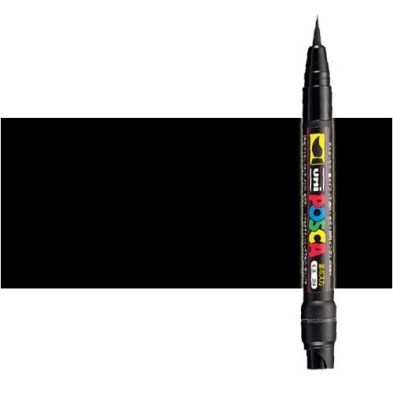
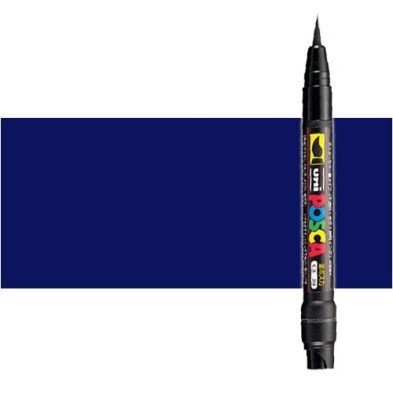
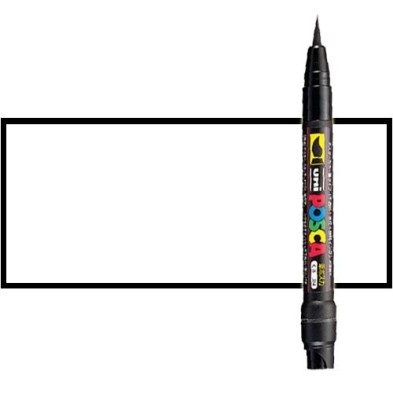
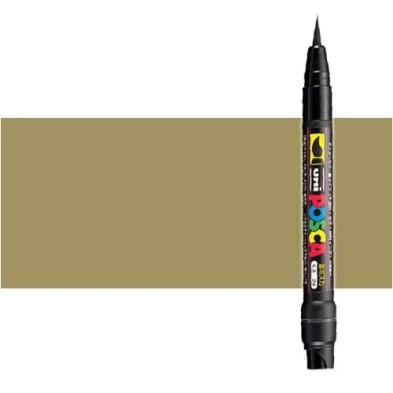
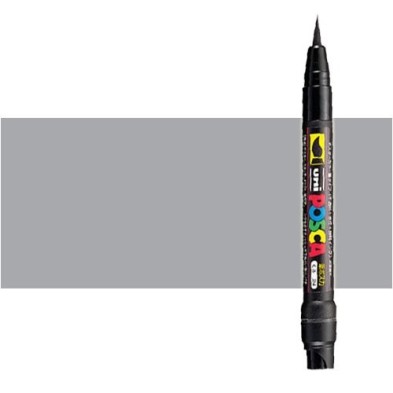
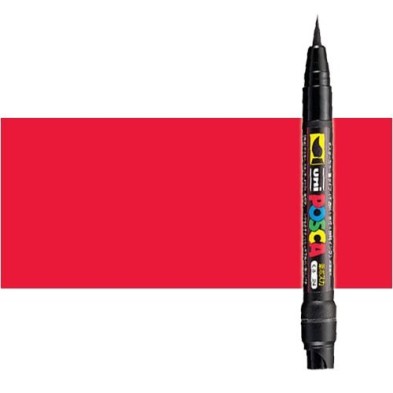
The manufacturer makes the PCF-350 in ten colours: white, yellow, pink, red, blue, light blue, green, black and the two metallics, gold and silver. The metallics are the ones with fewest alternatives elsewhere in the range, and on a brush tip they are the most direct route to gold or silver lettering on dark paper without reaching for ink and a nib.
The PCF-350 has no reversible tip — only the PC-3M and PC-5M do — and the manufacturer offers no replacement tip for this reference. You can see every nib size and compare the whole range on the POSCA pens and markers page.
Frequently asked questions about POSCA PCF-350 pens
Why does the PCF-350 not have a fixed tip width like the rest of the POSCA range?
Because its tip is not a nib size, it is a polyester fibre brush that gives under pressure and returns to its point when you lift your hand. The same pen draws from 1 to 10 mm depending on how hard you bear down. Rigid tips behave the opposite way: a PC-3M draws between 0.9 and 1.3 mm and a PC-5M between 1.8 and 2.5 mm almost regardless of pressure, because there it is the angle you hold the pen at that shifts the width slightly.
Can the PCF-350 be thinned with water for washes?
Yes, while the paint is still wet: lay the stroke down and, before it dries, a damp brush softens the edge and gives a watercolour effect. Once dry, the acrylic paint is water-resistant and stays put, which is exactly what makes layering possible. Test it on an offcut of the same paper, because the result depends a great deal on the weight and the sizing of the sheet.
What do I do if the brush tip splays or bends out of shape?
The manufacturer does not sell a replacement tip for the PCF-350, so the one it comes with is the one you have and it pays to look after it: do not crush it against hard edges or twist it on rough surfaces, and store the pen lying flat. A slightly splayed tip usually recovers its shape after painting for a while with light pressure on smooth paper. Once it is bent at the base, it will not straighten.
Is the PCF-350 any good for filling large grounds?
That is not its job. At 10 mm it covers a medium shape well, but holding the pressure steady across a background is awkward and the tip takes on paint over long sweeps. For backgrounds, signage and murals there are the covering nib sizes in the range, which you can compare on the POSCA pens and markers page. The usual pairing is a wide nib for the fill and the PCF-350 on top for gestural detail and gradients.