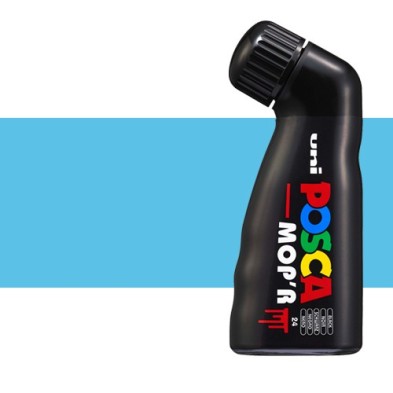
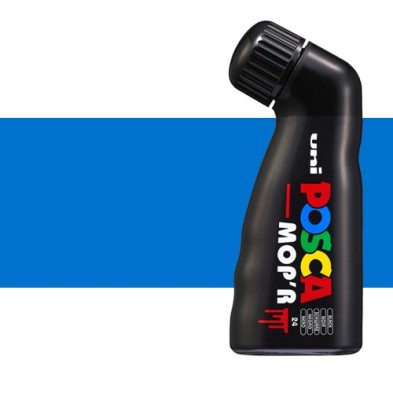
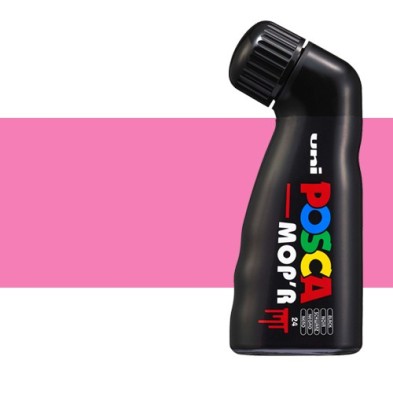
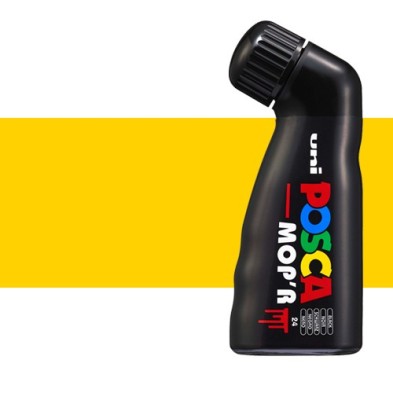
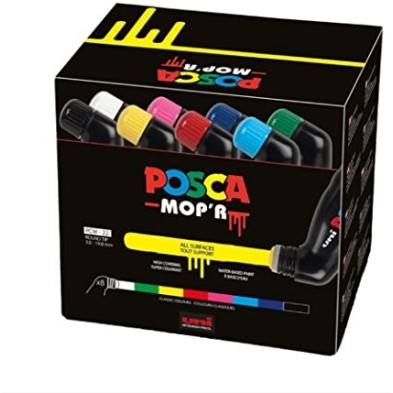
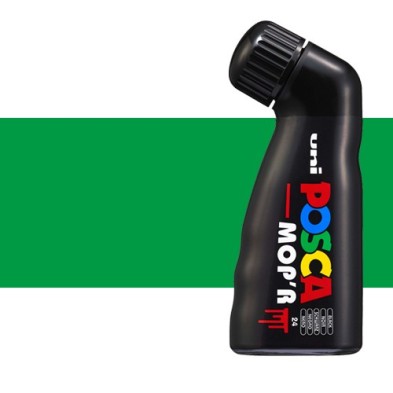
What the POSCA MOP'R is, and how it differs from the rest of the range
Every other POSCA has a fixed calibre: a fibre tip that delivers the same width every time. The MOP'R does not. Its tip is a round foam pad, and the width is decided by your hand: held on its edge it draws a line of around 3 mm, laid flat it covers up to 19 mm. Within a single pass you can go from outline to fill without changing marker.
The second difference is the body. The MOP'R is not primed by pumping the tip like the rest of the range: it is a semi-rigid bottle with a valve, and the ink comes out when you squeeze. That gives it a far larger reserve than a conventional marker, and it lets you work upside down, which is how the long drips and the splatter are made.
The ink is the same across the whole POSCA range: water-based acrylic, pigmented, opaque and matt, odourless, free of solvents and alcohol, lightfast, water-resistant once dry and layerable. Permanent on porous surfaces and removable on non-porous ones.
Where a hand marker ends and a wall marker begins
The PC-8K and the PC-17K are the wide fibre-tip calibres; the MOP'R is a different animal. This table compares what actually decides the choice at large scale: how much surface one pass covers, how the ink comes out and what kind of edge it leaves.
| Range | Stroke width | What one pass covers | How the ink is delivered | Edge of the stroke |
|---|
| MOP'R (PCM-22) | 3-19 mm, varying with angle and pressure | A band up to 19 mm wide: XXL fills and backgrounds in a few passes | Semi-rigid bottle with a valve: squeeze to release, upside down for more | Soft and blendable, drips if loaded |
| PC-17K | Fixed 15 mm | Straight bands and large lettering read from a distance | Bevelled fibre tip, constant flow | Straight and defined, turns a clean corner |
| PC-8K | Fixed 8 mm | Thick strokes, signage and the large detail of a mural | Bevelled fibre tip, constant flow | Straight, two widths depending on the edge used |
In short: if the job calls for a straight edge, tidy bands and clean-outlined lettering, the place to look is the PC-17K or the PC-8K. If it calls for ink volume, gesture and surface covered fast, it is the MOP'R. They do not replace each other: on a mural you end up using both. The rest of the brand's calibres are in POSCA markers.
Getting the most out of the valve
Before you start, shake the MOP'R with the cap on and press it several times on scrap paper until the foam is soaked edge to edge. From then on the control is all in your hand: light pressure keeps the stroke narrow, and squeezing the body as you drag opens the band and saturates the colour.
Upside down the ink falls under its own weight and the flow jumps: that is the position for long drips on a vertical surface. Pressing and lifting without dragging leaves clean round dots, and a sharp tap on the body with the tip a few centimetres from the surface throws splatter. On a horizontal surface the tip is more precise than it looks and takes thick lettering.
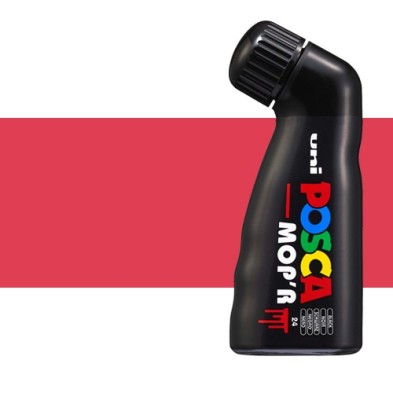
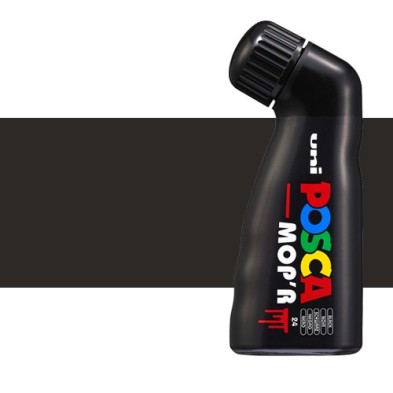
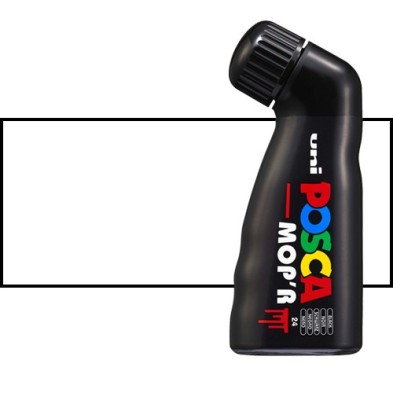
Rinse the foam with water before the paint dries inside it, especially when moving from a dark colour to a light one. All 8 colours are sold singly and together in the MOP'R 8-colour set.
Frequently asked questions about the POSCA MOP'R
How do you get a fine stroke out of a 19 mm tip?
By tilting the marker and working with the edge of the pad instead of its flat face. Held almost on its side and without squeezing the body, the MOP'R comes down to about 3 mm, barely more than a PC-5M. The difference from a fixed calibre is that this width is not guaranteed: it depends on your hand. For lines that all have to come out identical, a PC-5M or a PC-8K is still the right tool.
What happens if I use the MOP'R upside down?
The ink falls under gravity and far more of it comes out than in the normal position. This is the mode the manufacturer intends for drips: you drop ink at the top of the mark and let it run. On a vertical surface, test on card first, because the drip starts immediately and cannot be taken back. If you want flat coverage with no runs, use it the right way up.
Will the MOP'R hold up on an outdoor wall?
On a porous support —concrete, brick, mortar, untreated wood— the water-based acrylic ink soaks in and dries permanent and water-resistant. Outdoors, what eventually dulls the colour is not rain but sunlight, so a piece meant to last years is worth sealing with an acrylic spray varnish. On non-porous surfaces such as painted metal or tile the ink does not soak in and can be removed.
Why does the MOP'R leave colour flatter and more textured than a PC-5M?
Because foam lays down considerably more paint per pass than a fibre tip. The film left behind is thicker: it covers in one go even over a dark ground, but it takes longer to dry on non-porous supports and the relief of the pass shows more. If you want an even surface with no tool marks, put the second coat on once the first is completely dry, not before.