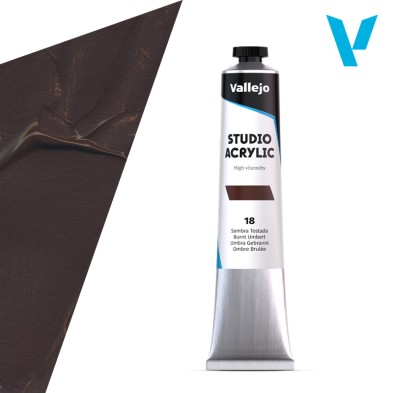
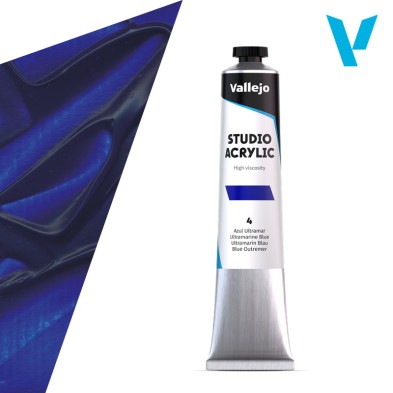
How Vallejo Studio acrylic handles
Studio is Acrylicos Vallejo's studio range, built for people starting out and for painting in quantity. Its high viscosity — 15,000 to 18,000 mPa·s — means the paint stays where you put it: it does not self-level, so the brushstroke and the knife mark are still there once it dries. It carries a lot of pigment, slightly less than the Artist Acrylic range, and that shows in bright colours and in coverage that hides in one pass across most of the opaques.
- Viscosity: 15,000–18,000 mPa·s (high, a light heavy-body).
- Finish: satin to matt depending on the colour; mostly opaque.
- Permanence: AA across most of the chart, A on several, B on the fluorescents.
- Lightfastness: ASTM I or II on the colours with a published rating.
- Thinning and clean-up: with water; wash brushes with soap and water before the paint dries.
Colours and sizes
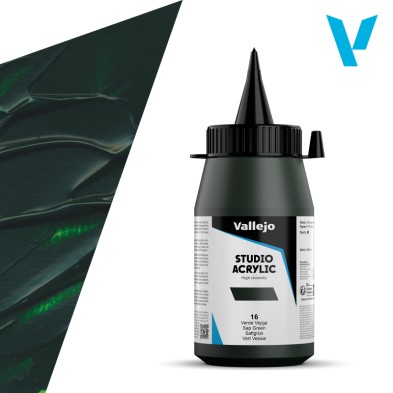
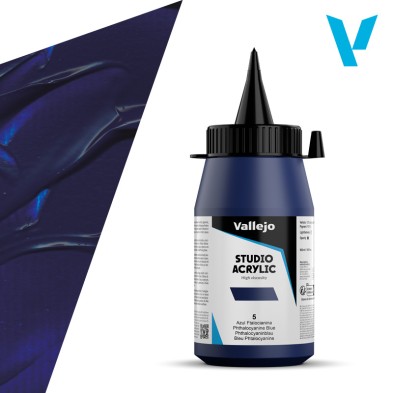
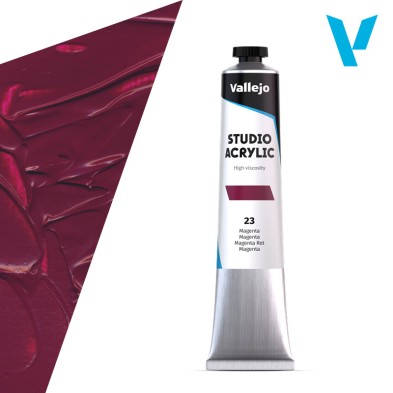
The chart runs to 62 colours. It covers a full base of earths and iron oxides, the cadmium hues made without real cadmium, phthalocyanines, quinacridones, three metallics (gold, silver and copper), eight fluorescents and a blacklight-reactive white. At Totenart you can pick the 58 ml tube for everyday work, or 200 ml, 500 ml and 1 litre jars when you paint large or lay in grounds.
What you can paint on
Canvas, wood, paper, board, plastic and metal. On low-porosity or very absorbent surfaces it is worth priming with gesso first, so the colour grips and does not sink in.
Studio or Artist: which one suits you
Studio carries less pigment than Artist Acrylic and has a shorter chart, in exchange for a much lower price and large sizes. If you are learning, painting a lot, laying in grounds or working large, Studio has plenty to give. If you want the highest pigment concentration and single pigments for archival work, that is where Artist comes in.
Frequently asked questions about Vallejo Studio acrylic
How many colours are there in the Vallejo Studio range?
62 colours, including three metallics (gold, silver and copper), eight fluorescents and a blacklight-reactive white.
What sizes does Vallejo Studio acrylic come in?
Acrylicos Vallejo makes it in 58 ml, 125 ml, 200 ml, 500 ml and 1 litre. At Totenart we stock the 58 ml tube and the 200 ml, 500 ml and 1 litre jars.
What is the difference between Vallejo Studio and Vallejo Artist?
Studio carries slightly less pigment than Artist Acrylic and has a shorter chart, but it keeps the same high viscosity and costs considerably less. Artist is the maximum-pigment range, made for professional work.
Is Vallejo Studio acrylic good for beginners?
Yes: it was formulated for exactly that. It thins with water, dries fast, covers well, and the large sizes bring the price per millilitre right down.
Do the Vallejo Studio cadmium colours contain cadmium?
No. The ones marked «(Tono)» — cadmium lemon yellow, cadmium yellow light, cadmium yellow deep, cadmium red and dark cadmium red — are hues made with arylamide (PY3, PY83) and naphthol (PR112) pigments, with no cadmium pigments at all. The same goes for cobalt blue and cobalt violet, formulated with PB29 and PR122.
What do AA, A and B mean on the permanence rating?
It is the manufacturer's permanence scale: AA is maximum permanence, A is good permanence and B marks a colour of limited permanence. The eight fluorescents and the UV white are B, because fluorescent pigments lose intensity on exposure to light.
Can it be thinned with water, or do I need a medium?
Water thins it perfectly well. If you want to drop the viscosity while keeping gloss and adhesion, Vallejo makes its own gloss medium within the same range.
Do I need to prime before painting?
Not on pre-primed canvas. On wood, board, heavy paper, plastic or metal it is worth laying a coat of gesso to seal the surface and improve adhesion.