




Unit price (tax included)

Free shipping on orders over €95
Free returns within 14 days
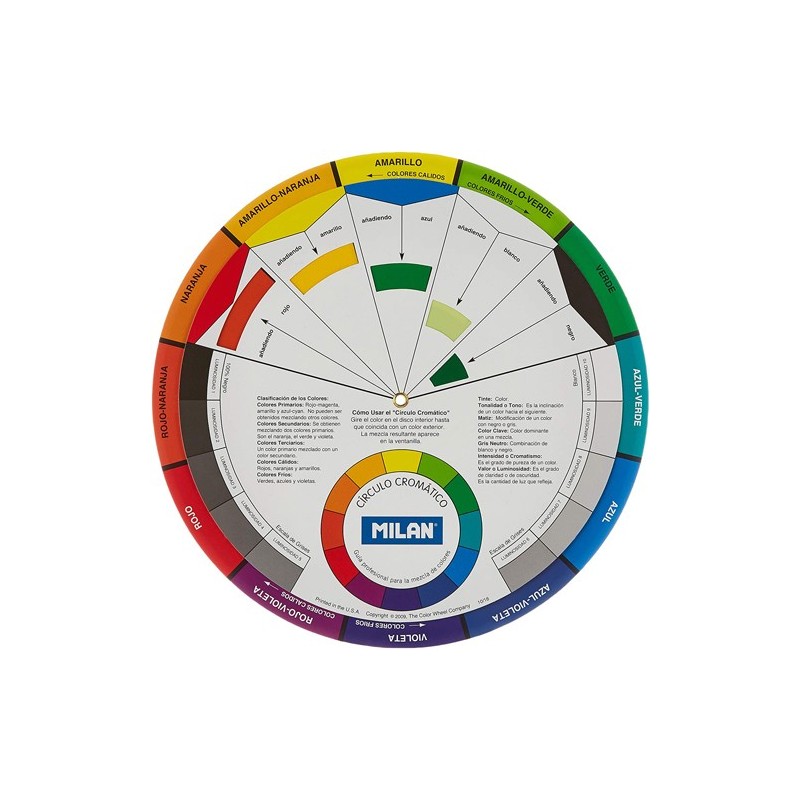
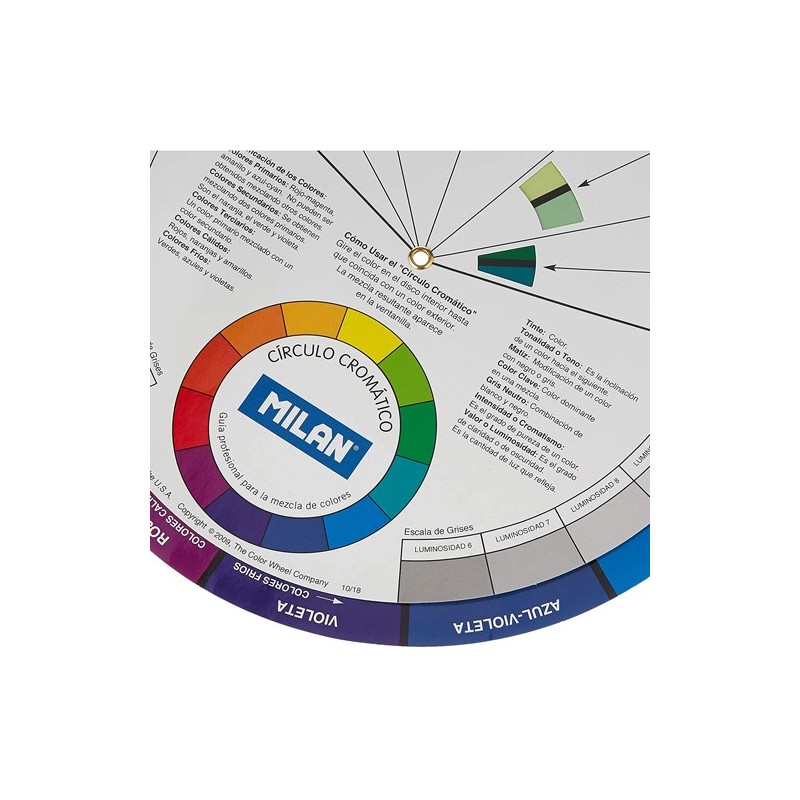
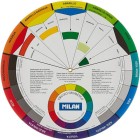
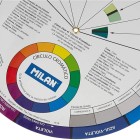
Turn the inner disc until the colour you want to mix lines up with the reference colour on the outer ring: the resulting mix appears automatically in a cut-out window on the disc. It's the same system used in The Color Wheel Company's professional colour wheels.
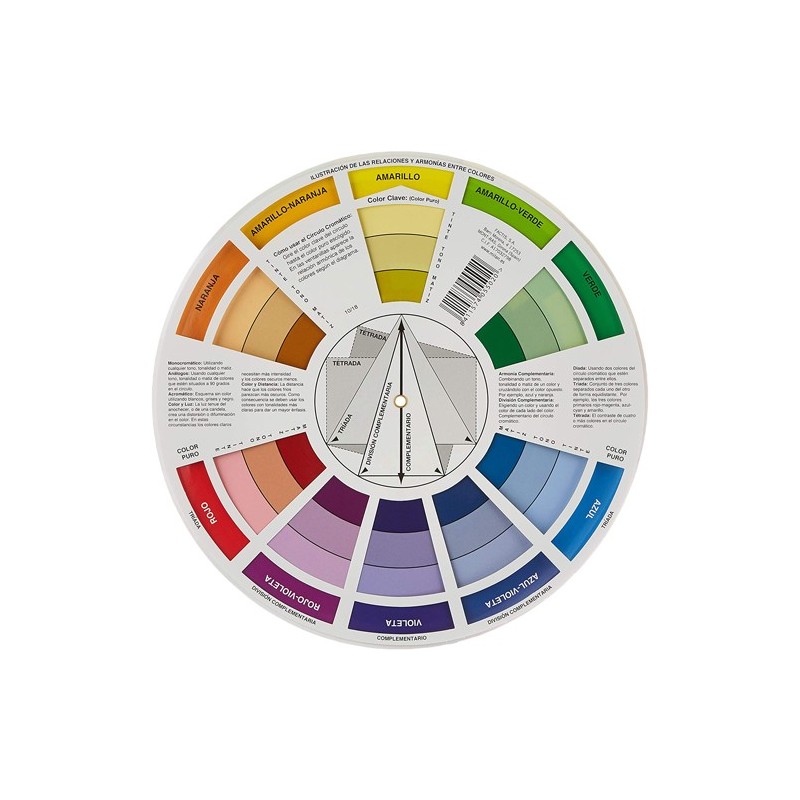
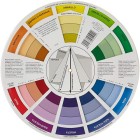
The front side mixes colours: turn the disc and the window shows what tone you get by adding blue, white, black or red to a base colour. The back side identifies colour harmonies through a rotating pointer that marks out monochromatic, analogous, complementary, split-complementary, triadic and tetradic combinations.
All 12 colours of the traditional painter's wheel: 3 primary colours (red, yellow and blue), 3 secondary colours (green, orange and violet, made by mixing two primaries) and 6 tertiary colours, made by mixing a primary with its adjacent secondary.
Because it follows the traditional painter's colour wheel (the RYB model), designed for mixing pigments the way you would on a palette, rather than the subtractive print model (CMY) or the additive screen model (RGB). It's the convention taught in fine art courses and also used by decorators and product designers.
It's a disc made from high-quality printed card, 23.5 cm in diameter and weighing around 100 g. It's manufactured and printed in the USA by The Color Wheel Company, under the MILAN brand for the Spanish and Portuguese markets.
Monochromatic (variations of a single colour), analogous (neighbouring colours on the wheel), complementary (opposite colours), split-complementary, triadic (three equidistant colours) and tetradic (four colours in complementary pairs). The back disc includes a rotating diagram to locate each one without any calculations.
For painters and fine art students who need to work out mixes and harmonies without trial and error on the canvas, as well as for graphic designers, decorators and photographers working with colour combinations in their projects.
Hue is how far a colour leans toward another; tone is a colour modified with black or grey; and value (or luminosity) is how light or dark a colour is — the amount of light it reflects. This wheel prints all three definitions alongside a reference grey scale.
Unleash your creativity without spending more, take advantage of our free shipping on orders over €95 (Spain and mainland Portugal, and Balearic Islands).
Also, so you don’t miss anything, we will always keep you informed about the status of your order, through your customer account, by email, and with a link to the carrier tracking when your order is out for delivery.
We put a lot of effort into ensuring our products reach your home in perfect condition, however, if they arrive damaged, notify us within 24 hours so we can resolve it, and if you change your mind and want to return any product, you have up to 14 calendar days to do so.
We only accept returns due to defects in the product and will not be held liable for installation errors where the installation has not been carried out by our technicians. We accept returns within 14 calendar days of the delivery date, subject to our prior approval, confirmed by email or other means.
Refunds will be issued via the original payment method within a maximum of 7 calendar days of our confirmation.
At Totenart we love art, and that’s why we work every day to make it more accessible and closer to you. We want living art to be as easy as feeling it, which is why you can now find galleries, museums, and cultural spaces from all our cities in one single place. The best part? They’re organized in an interactive map that allows you to explore them easily and visually, wherever you are.
Whether you’re passionate about art or just beginning your creative journey, this resource will help you get inspired, discover new spaces, and enrich your artistic experience.
And if you are an artist, we invite you to take it a step further: join our artist directory. It’s the perfect opportunity to showcase your work, gain visibility, and connect with art lovers, fellow creators, and potential clients.
Are you a trainer or do you run a workshop? You can also register in our training centers directory. Let more people know about your space, your courses, and your artistic proposal.
Because we believe art is meant to be shared, to build networks, and to grow together.
We have more than 50,000 products on our website, but not all of them are available in our physical store.
If you are interested in this product and want to buy it at our store in Valencia, please make sure we have it there beforehand.
You can send us an email letting us know how many you need and when you plan to come, and we will confirm the stock or notify you when it’s available so you can pick it up!
Shopping in Valencia
You may also like





Recently viewed